
The inverter can make coffee, but what does that mean for your battery?
You find a 1,000 W pure sine wave inverter and think that should be more than enough for a laptop and the odd cup of coffee. Then you discover that some appliances need a much bigger burst of power when they start. Later you wonder whether two hours of driving will really replace the electricity you used.
Those are two different decisions, an inverter needs to handle the loads running together and the brief start-up demand. Your charger then needs time and a battery willing and able to accept the charge. Our calculator helps you plan both, without pretending to approve the installation.
Calculate inverter size and recharge time
Enter each appliance’s running wattage and its start-up wattage, where available. Select only the appliances you might use at once. Then choose your battery capacity, current charge level, target charge and the charger’s actual output current.
All pre-filled loads and margins are illustrative starting values, not measured data for your own equipment. This calculator does not select cables or fuses.
Running power and start-up power are not the same thing
An inverter’s continuous power rating tells you what it can supply while your appliance runs. Manufacturers may also specify a higher surge rating for a very short time, a simple resistive loads can be relatively straightforward; compressors and motor-driven equipment are more demanding at switch-on. Rather than assuming everything starts at two or three times its running power, check the appliance specification.
Example: an 800 W appliance plus a 90 W laptop charger.
An illustrative minimum continuous inverter rating before looking at product classes.
The peak rating must match the appliance’s actual start-up demand and duration.
Be careful with an inverter advertised as “2,000 W peak”. Peak duration matters. A motor that takes several seconds to start may not be satisfied by a product that briefly reaches its surge rating for much less time.
A 900 W mains appliance can draw over 80 A from a 12 V battery
AC wattage is not the same as battery power because the inverter has losses, at illustrative 90% efficiency, a 900 W appliance draws roughly 1,000 W from the battery. At a nominal 12 V, that is about 83 A. As battery voltage falls under load, actual current can rise.
That is why the battery BMS, conductors, protection and the inverter must work as a system. Our electrical-system guide, cable calculator and fuses and electrical safety guide cover those separate decisions.
How long must I drive to recharge a leisure battery?
A 30 A DC-DC charger will not necessarily deliver 30 A to your battery continuously, because the alternator has other work to do. The charger may have an input-current limit and a battery approaching full charge may accept less current. You can adjust the calculator’s expected average delivered current to reflect this uncertainty.
| Example | Calculation | Result |
|---|---|---|
| 200 Ah battery | 30% → 90% | 120 Ah to replace |
| 30 A DC-DC charger | 120 ÷ 30 | 4.0 h theoretical minimum |
| 85% delivered average | 120 ÷ 25.5 | ≈4.7 h planning estimate |
AGM charging and charging all the way to 100% can take longer than a simple Ah ÷ A calculation suggests. The tool applies an openly labelled illustrative slowing factor towards the end of charging, not a precise model-specific charge curve.
Our separate electrical guide explains how alternator, solar and mains charging fit together. Do not automatically add solar and DC-DC rated currents: combination units can share limits and the battery itself can restrict total charge acceptance.
20A, 30A or 50A charging, what changes?
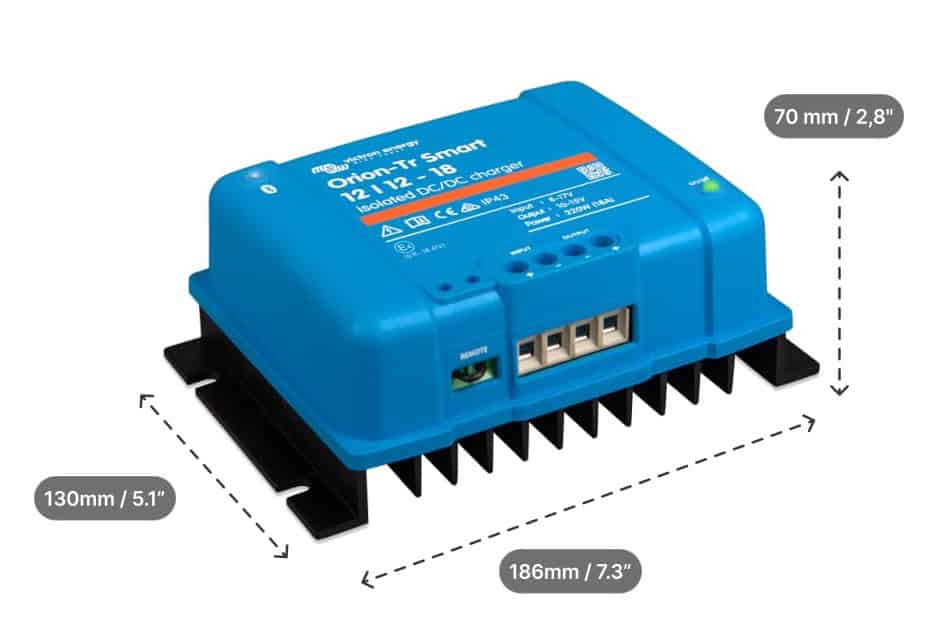
The manufacturer quotes up to 20 A charge output. A useful reference for longer driving days.
A handy planning scenario. Actual output depends on the charger, alternator and battery.
Adjustable up to 50 A in the documented 12/12-50A model, subject to system limits.
A larger charger is not automatically the better or safer choice. Check alternator capacity while driving and idling, charger input-current limits, battery specifications, BMS and temperature. Our DC-DC charger guide explains what the charger does and when it makes sense.
Driving and mains hook-up are different charging paths
Several sources of charging can serve the same battery, but their nameplate currents do not always add together, and they cannot simply be wired together without a coordinated design. Mains hook-up involves 230 V safety requirements that are outside this calculator.
What the numbers mean
Our calculation method
Inverter: add the running power of selected appliances and apply the chosen margin. To illustrate one start-up at a time, add the single largest extra start-up demand to the running total.
Charging: battery capacity in Ah multiplied by the percentage gap gives missing amp-hours. We compare the ideal at rated current with a user-adjustable lower average and a simple late-charge slowing factor.
It does not simulate fluctuating alternator power, changing battery temperature or multiple motors starting at once.
Five checks before choosing equipment
Begin by checking (1) actual appliance running and start-up ratings; (2) inverter continuous and time-limited peak power; (3) battery discharge current and BMS; (4) charging profiles, chemistry and alternator capacity; and (5) appropriately designed DC cabling, fuses, earthing, AC protection and 230 V installation.
This is not a wiring diagram or electrical approval. Always seek a competent professional for unfamiliar AC work or any electric installation that you are unsure or not qualified for.
Where practical, choose efficient 12/24 V appliances and USB-C charging so you do not have to leave a mains inverter running constantly. An inverter is brilliant when you truly need a particular 230 V appliance, not as a reason to make every appliance AC-powered.
Common questions
Is a 1,000 W inverter enough for my campervan?
It depends entirely on what runs at once and how it starts. A 1,000 W continuous rating can cover modest appliances, but you must also check the surge rating and the battery side.
How much charge do I gain during two hours of driving?
At a genuine average of 30 A into the battery, two hours would theoretically add 60 Ah. Reduced output, high state of charge or cold battery conditions can lower that figure.
Can I use a 12 V DC-DC charger on a 24 V leisure battery?
Only where the manufacturer expressly specifies that input/output combination. Selecting 24 V in this calculator does not make a 12 V charger compatible.
Does this tool recommend cable size or fuse ratings?
No. It estimates power and charging time only. Conductors, fuses, installation conditions, AC protection and compliance require separate assessment. Check out our campervan Cable Size Calculator – Check Voltage Drop & Fuse Requirements.
Sources and limitations
These calculations are planning estimates, not a performance guarantee or a safety certification. Inverter efficiency varies with load, batteries have limits and charging tapers. Always compare the result with the current manual for your particular model.
Manufacturer references checked November 2026: CTEK D250SE, Victron Orion XS, Victron inverter selection, and Renogy inverter example.
The hero image is AI-generated editorial artwork, not a tested CamperPals installation or a wiring diagram. Read our complete electrical overview and cable-sizing calculator before planning actual wiring.