Campervan Diesel Heater Calculator – Is 2kW Enough?
Estimate heat demand, diesel use and battery consumption before your next cold night.
Calculate for your campervan ↓A cold night starts with the right plan
It is minus ten outside and you have found the perfect place to camp off-grid. The fuel tank is filled and the leisure battery is charged. But will the heater keep the van warm all night, and how much diesel and battery capacity will you actually need?
A lot of peaople that have contact us for edvice and ask if bigger is better? A larger diesel heater is not automatically a better choice for your van. The aim is to replace the heat escaping through the bodywork, windows, floor and ventilation without constantly starting and stopping the heater. The calculator below helps you compare heat demand and plan consumption before making that decision.
Calculate your diesel heater requirements
Choose an approximate van size or enter your own dimensions. Set the outside temperature and your desired indoor temperature. Once you see the heat demand, compare the heater’s output range and explore how different settings affect diesel and battery consumption. Vehicle dimensions are illustrative, not verified model specifications.
Consumption refers to your chosen number of active running hours, not an automatically simulated thermostat cycle. If you already own a heater, use the figures from its data sheet or your own measurements.
2kW or 5kW – why both output limits matter
When comparing diesel heaters, it is easy to focus only on maximum output. Think instead about two situations. On a cold evening after the van has been parked all day, you need to warm the air and the interior fittings. Once the van is warm, the heater only needs to replace ongoing heat loss. That requirement can be much lower than during warm-up.
A starting point for a small or insulated van. Check cold nights and warm-up time.
Check whether a larger envelope, colder climate or higher heat loss justify more output.
A low minimum output can help maintain steady warmth in milder conditions.
If the estimated demand is below the heater’s minimum output, it may need to shut down and restart. How it behaves depends on the controller. Prolonged low operation and soot build-up are model-dependent; follow the manufacturer’s operating and servicing advice rather than a universal routine for burning off soot.
How much diesel does a heater use overnight?
Fuel consumption depends on the heater’s output and how long it runs. The table shows two actual output ranges and another 2kW example using manufacturers’ running consumption figures. Eight hours at constant minimum and maximum operation gives the two endpoints in the last column. It is not a forecast for a night with thermostatic control.
| Model | Heat (kW) | Diesel (L/h) | Electricity (W, 12 V) | Diesel 8 h (L) |
|---|---|---|---|---|
| AUTOTERM Air 2D | 0.8 – 2.0 | 0.10 – 0.24 | 10 – 29 | 0.80 – 1.92 |
| AUTOTERM Air 4D | 1.0 – 4.0 | 0.12 – 0.51 | 10 – 57 | 0.96 – 4.08 |
| Webasto Air Top 2000 STC | 2.0 max | 0.12 – 0.24 | 14 – 29 | 0.96 – 1.92 |
Sources: AUTOTERM Air 2D, AUTOTERM Air 4D and Webasto Air Top 2000 STC. Accessed 24 November 2026. Start/stop and standby are excluded from the table.
If you have a separate 10 litre tank and want to keep two litres in reserve, eight litres are available for planning. At 0,17 L/h, that is around 47 active running hours. At eight hours per night, it represents roughly five complete nights in that particular scenario, before additional start fuel. If you use the vehicle tank, allow for the fuel needed to drive away too.
How much battery power does a diesel heater need?
Diesel provides the heat, but the heater still needs electricity for the fan, pump, controller and glow plug. Our example uses the Air 2D and an interpolated middle setting. Eight hours at 19,5 W gives 156 Wh. Add an illustrative allowance of 10 Wh for a start/stop cycle and the total is 166 Wh, or about 14 Ah at a nominal 12 V.
A 100 Ah battery with an assumed 80% usable share has 960 Wh available in a simplified 12 V calculation. The heater therefore uses about 17% of that energy overnight. The fridge, lighting and other loads are additional. The glow plug can briefly draw considerably more current than during steady operation; check your model’s starting current and voltage requirements. Use our cable calculator to check voltage drop and always follow the heater installation instructions.
Insulation, windows and outdoor temperature change the answer
The same heater can work well in a well-insulated van and struggle in a larger one with many windows. It depends on how quickly heat escapes. If the temperature difference doubles, heat loss is approximately doubled, all else being equal.
An example van measuring 2.6 × 1.65 × 1,4 m internally, at 20°C inside and −10°C outside, gives roughly 0,74 to 1,41 kW in the calculator’s typical insulated scenario. A 2kW unit is therefore worth investigating, but it is not guaranteed to cope in all weather or from a cold start.
Curtains, draught reduction and insulation can help, but never close necessary ventilation to save fuel. Remember that heat alone does not remove moisture, ventilation is still needed to manage condensation from occupants and cooking.
Two separate air paths, an important safety principle
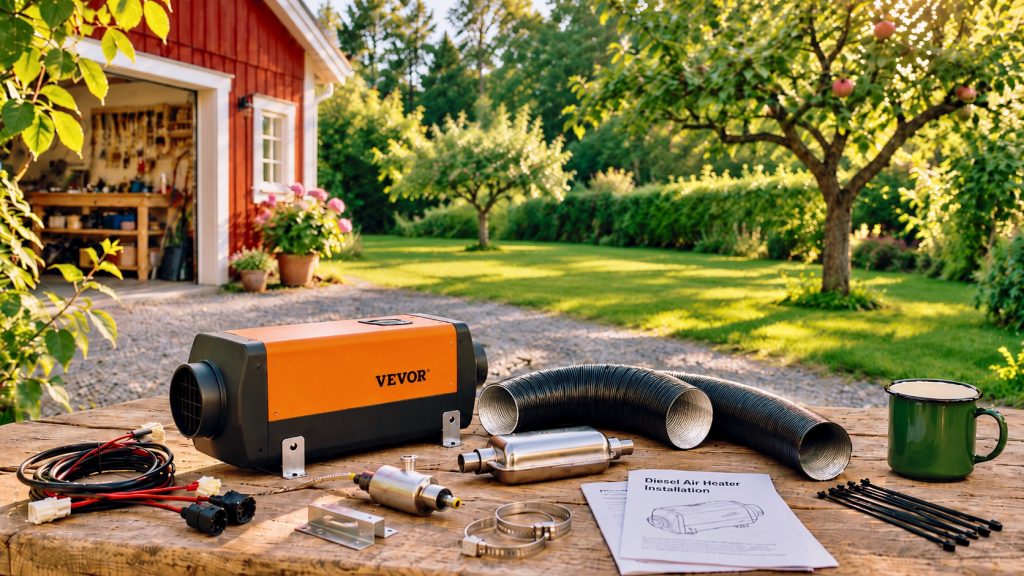
A diesel heater for the living area must be suitable for that installation. Combustion air and exhaust must be kept separate from cabin air and routed according to the manufacturer’s instructions. An incorrectly installed or leaking heater can cause fire or carbon monoxide poisoning. Use a suitable CO alarm for leisure vehicles and have a competent installer check the installation if in doubt.
Do not disconnect power during the automatic cool-down cycle, check the manufacturer’s requirements for altitude, ventilation and air ducts.
See our guide to gas and diesel heaters for more guidance.
How CamperPals calculates and works
We use a simplified steady-state heat balance for a rectangular van. The model uses estimated envelope area A in m², effective U-value in W/(m²K), heated volume V in m³, assumed air changes n per hour and the temperature difference ΔT.
Actual vehicle shape, wind, thermal bridges, door openings and insulation may produce higher or lower losses. The model excludes warming the interior fittings, solar gains and occupants’ body heat. The result is a scenario range, not a statistical confidence interval. We interpolate between the manufacturer’s minimum and maximum figures; actual consumption curves need not be linear.
Once you know roughly how much heat you need, the next step becomes easier: select a heater with a suitable output range and check that you can supply both fuel and electricity. Our heating guide helps you compare the options.